
Three years ago, we announced Dolt 1.0, signalling that Dolt was ready for production workloads. We haven’t stopped improving the world’s first and only version-controlled SQL database. Today, we are excited to announce Dolt 2.0.

What Did Dolt 1.0 Mean?#
Dolt 1.0 meant four things:
- Forward Storage Compatibility
- Production Performance
- MySQL Compatibility
- Stable Version Control Interface
Dolt 2.0 maintains the promises of Dolt 1.0. Dolt 2.0 improves on the performance and correctness metrics established in Dolt 1.0.
What Does Dolt 2.0 Mean?#
Dolt 2.0 means five things:
- Automated Garbage Collection on by Default
- Archive Compression on by Default
- Faster than MySQL on
sysbench - Beta Vector Support
- Adaptive Storage
Unlike Dolt 1.0, Dolt 2.0 is fully backwards compatible with all Dolt 1.0 versions. No storage migration using dolt migrate is required. Let’s dive into the details of each of these points.
Garbage Collection#
Dolt makes a lot of disk garbage, especially during import. Dolt is copy-on-write so all intermediate committed transaction state is preserved to disk. Any intermediate state that is not in a Dolt commit is garbage and can be collected.
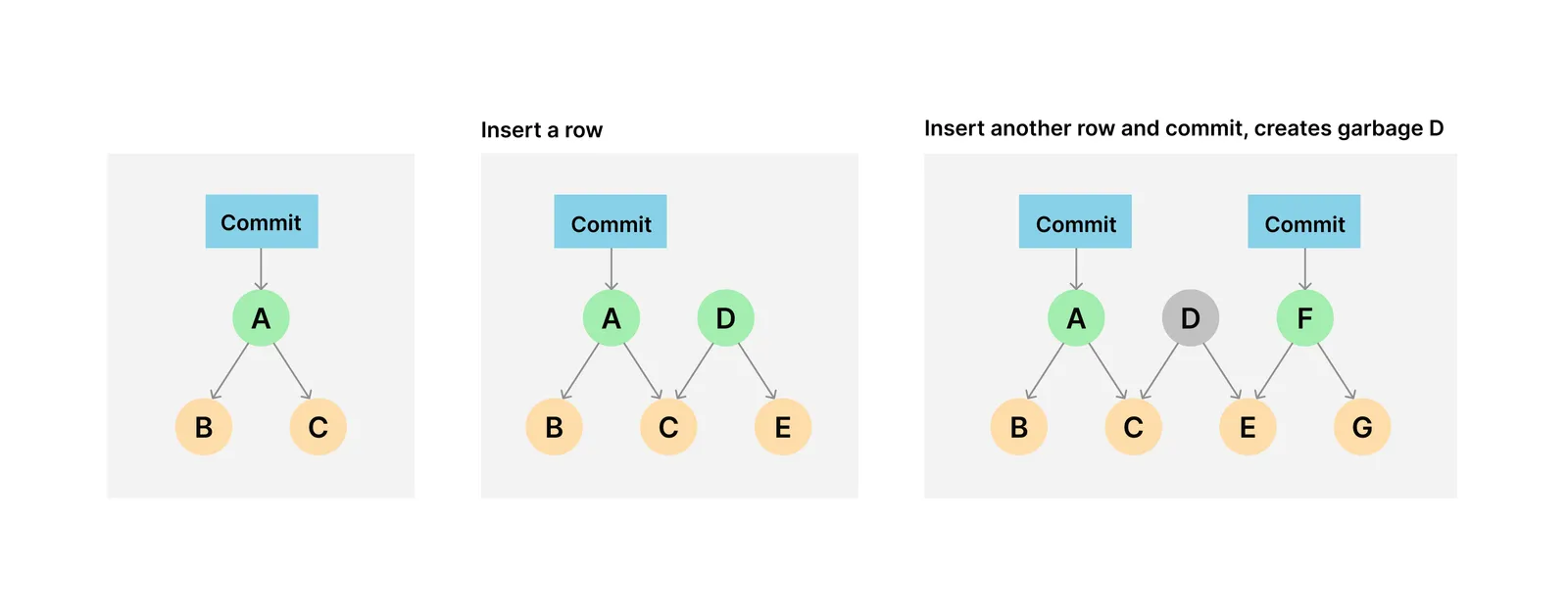
Dolt already must preserve all history in the commit graph on disk. Adding extra garbage can eat through your disk very quickly.
Dolt 2.0 has automatic garbage collection on by default, meaning most users don’t have to care about disk garbage. Many users have been running in this mode for over a year. We’re confident it is stable.
Dolt 2.0 databases do not require extra garbage maintenance, just like other modern SQL engines.
Archives#
Following on the disk space theme, we also have a new on disk format we call archives that can reduce Dolt’s storage footprint by an additional 30-50%. Archives use dictionary compression to de-duplicate storage in the deepest layers of Dolt, saving even more disk space.
As with automatic garbage collection, archives have been the default format for new Dolt databases for months. We’re confident the format is stable and delivers real disk space wins.
Dolt 2.0 databases are kind to your disk with automatic garbage collection and archives. Version control already requires more disk space than traditional databases. Dolt 2.0 preserves that disk for your data’s history.
Faster than MySQL on sysbench#
We’ve long used the industry standard sysbench to measure and benchmark the latency of simple SQL queries in Dolt. We started at about 10X slower on reads and 20X slower on writes than MySQL. We’ve worked tirelessly to improve Dolt’s performance and we are now 13% faster than MySQL on writes and 5% faster on reads, averaging out to 8% faster than MySQL on sysbench style workloads.
Dolt 2.0 databases deliver real production database performance coupled with version control functionality.
Beta Vector Support#
We announced vector index support early last year. We have a much bigger challenge than traditional databases with vector indexes because our vector indexes must be version-controlled. We’ve done the hard computer science to achieve this. We adopted the Vector type from MariaDB in September 2025.
Dolt 2.0 databases have Beta vector support. Dolt is the only database where your vectors are version-controlled. We still have some edge cases on the read query path where a vector index should be used but it is not. Closing these gaps will remove the Beta tag from Dolt’s vector support.
Adaptive storage for large column types#
Borrowing from our Doltgres adaptive storage work to support TOAST types, we’re excited to announce Dolt 2.0 has adaptive storage.
For large column types like TEXT, BLOB, and JSON, databases generally store the value “out of band”, as a file on disk with a pointer to the file in the actual table structure. A different strategy, popularized by Postgres, is to examine the size of the value and store small values in the table structure while preserving the files and pointers strategy for large values. This strategy allows the user to be less disciplined about sizing VARCHAR columns and just use TEXT instead. It’s also a big performance win for these types when the values are small.
Dolt 2.0 has adaptive storage making MySQL databases that use TEXT, BLOB, GEOMETRY, or JSON columns a good fit regardless of whether they need version control or not.
Conclusion#
Dolt 2.0 is here. It’s kinder to your disk and it’s fast. Questions? Stop by our Discord and just ask.