
We’ve been building Dolt for almost eight years now. The first seven of those years produced two Dolt flavors: classic MySQL-flavored Dolt and the much anticipated Postgres-flavored Doltgres. The past year has produced two additional flavors: the SQLite-flavored DoltLite and the MongoDB-flavored Dumbo. Coding agents rapidly accelerated our company’s ability to build new products. DoltLite and Dumbo are entirely agent-made.
Why all the flavors? Which flavor should you choose for your use case? Which flavors work with other services like Hosted Dolt or DoltHub? This article explains.
Why All the Flavors?#
Version control is useful, and essential if agents are involved, in every database format, and our product catalog now reflects that. Moreover, over the eight years we’ve been building Dolt, users have asked for almost every database flavor. There is demand for all manner of version-controlled databases.
Of the four Dolt flavors, only Dolt and Doltgres are redundant. MySQL and Postgres are mostly interchangeable as Online Transaction Processing (OLTP) SQL databases. DoltLite and Dumbo have completely different form factors. DoltLite is an embedded database, not an OLTP database. Dumbo is an OLTP database but not a SQL database.
So why Dolt and Doltgres? Database formats are very sticky. You are either a MySQL shop or a Postgres shop. Convincing people to switch database formats is harder than providing both options. Postgres has definitely become the default OLTP SQL format. This was not the case in 2018 when we started building Dolt. MySQL was still very popular. Today, not so much. A Postgres flavor is required in 2026. Doltgres goes 1.0 in August, signaling it is ready for production use.
Which Flavor Is Right for You?#
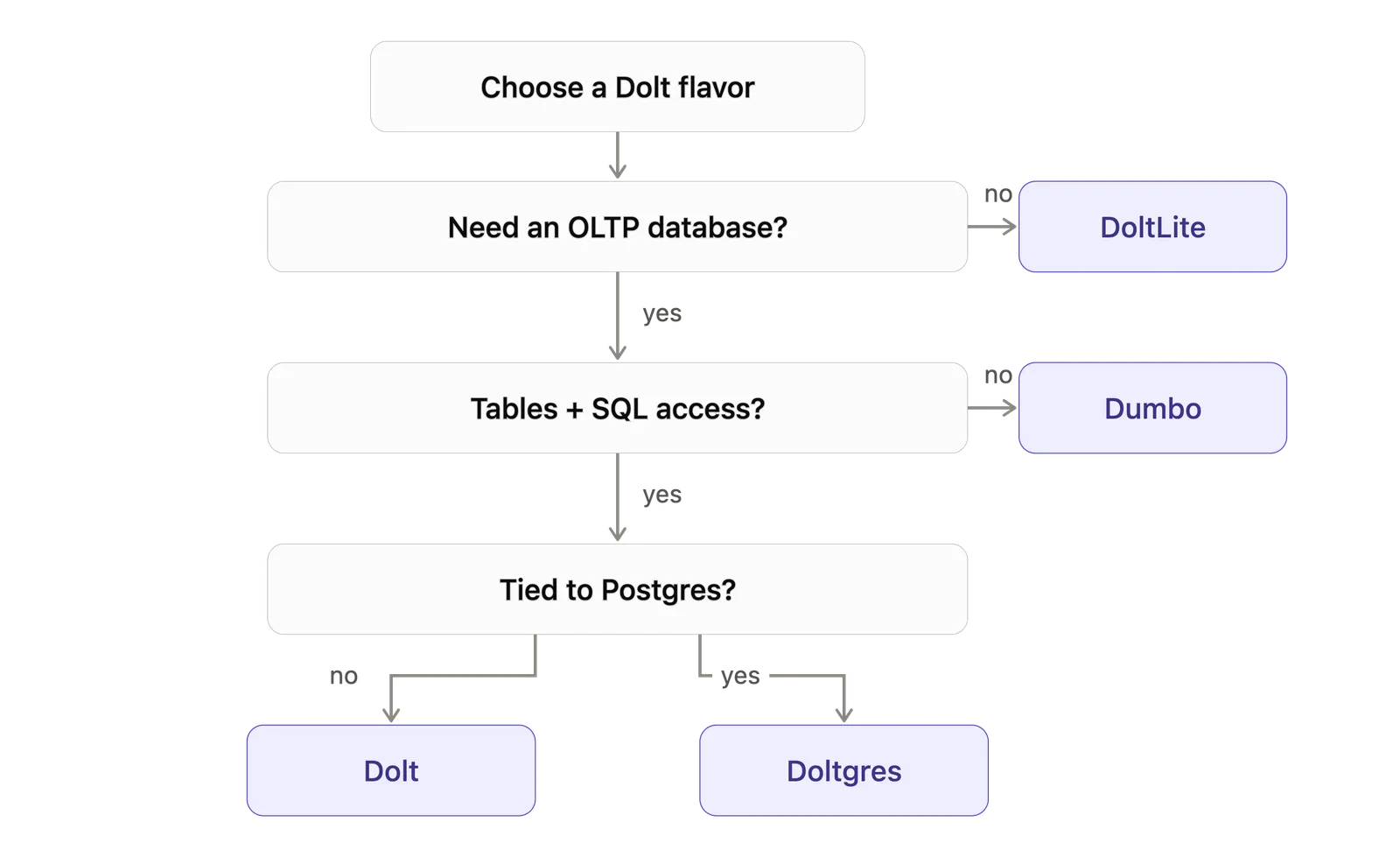
Now that Dolt has four flavors, how do you pick the flavor that is right for you? This really comes down to what type of database you need.
Do you want an OLTP database like MySQL or Postgres? Most OLTP databases are used to power the backends of websites or mobile applications. The database is run as a server that hosts one or many clients. If the answer to that question is yes, you have narrowed your choice down to Dolt, Doltgres, or Dumbo. If the answer is no, you probably want an embedded database and DoltLite is for you.
Do you want your data structured as tables and accessed using SQL? If yes, then you can choose between Dolt and Doltgres. If no, Dumbo’s document format is for you.
Choosing between Dolt and Doltgres comes down to your preference. Dolt is older and more stable. If you don’t care about SQL format, we always recommend choosing Dolt over Doltgres. If you are migrating from Postgres or wedded to Postgres as a company, choose Doltgres.
The Dolt Ecosystem#
What about DoltHub, DoltLab, Hosted Dolt, and the Dolt Workbench? If I want to share my data on DoltHub, can I use Doltgres?
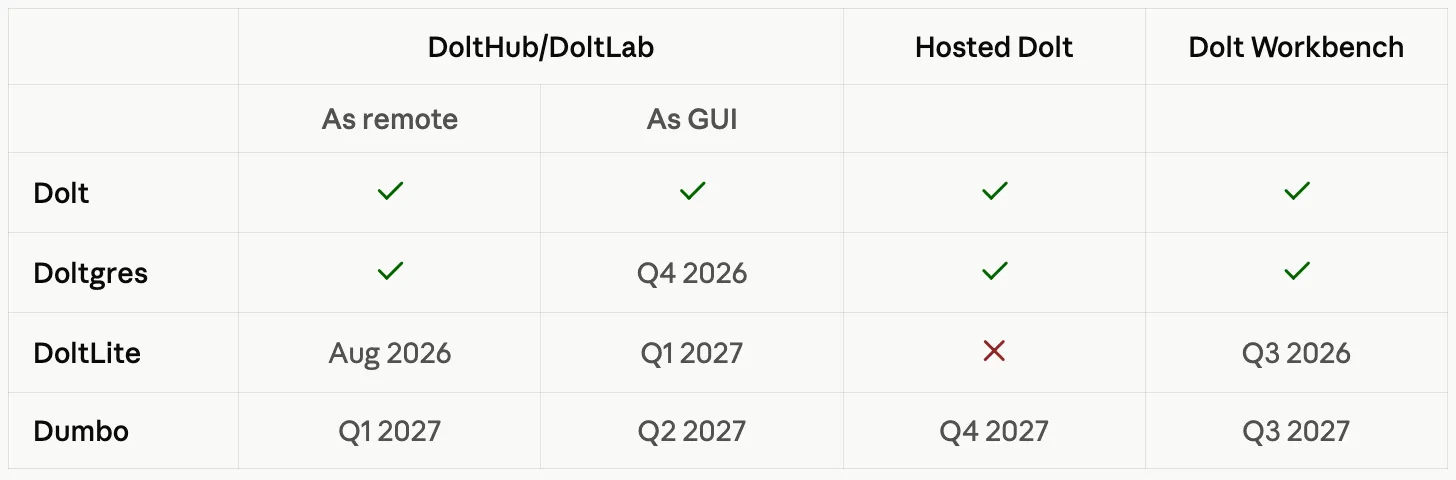
The goal is for all four flavors of Dolt to work with DoltHub, DoltLab, Hosted Dolt, and the Dolt Workbench with one exception: DoltLite will not be hosted. However, we’re probably 6-12 months away from reaching that goal.
With DoltHub and DoltLab, there are two components. Can you push to them as a remote? Can you view your database contents using the user interface? Supporting the first is pretty easy while supporting the second is more involved. User interface features are things like pull requests and SQL queries. Here’s a compatibility matrix with estimated dates for the unsupported cells.
Conclusion#
We now have the Dolt that is right for you! Be that classic Dolt, Doltgres, DoltLite, or Dumbo. Soon, all these databases will work with DoltHub, DoltLab, Hosted Dolt, and Dolt Workbench. Want something prioritized? Come by our Discord and let us know. We’re always willing to shift the schedule based on user feedback.