
Here at DoltHub, we love open data. Sharing open data is why we built Dolt in the first place. With the improvement in AI agents, using open data has never been easier. Just clone a database from DoltHub in Dolt Workbench and start asking the built-in agent questions. Follow along in a standard workbench UI on the left side. The experience is magical.
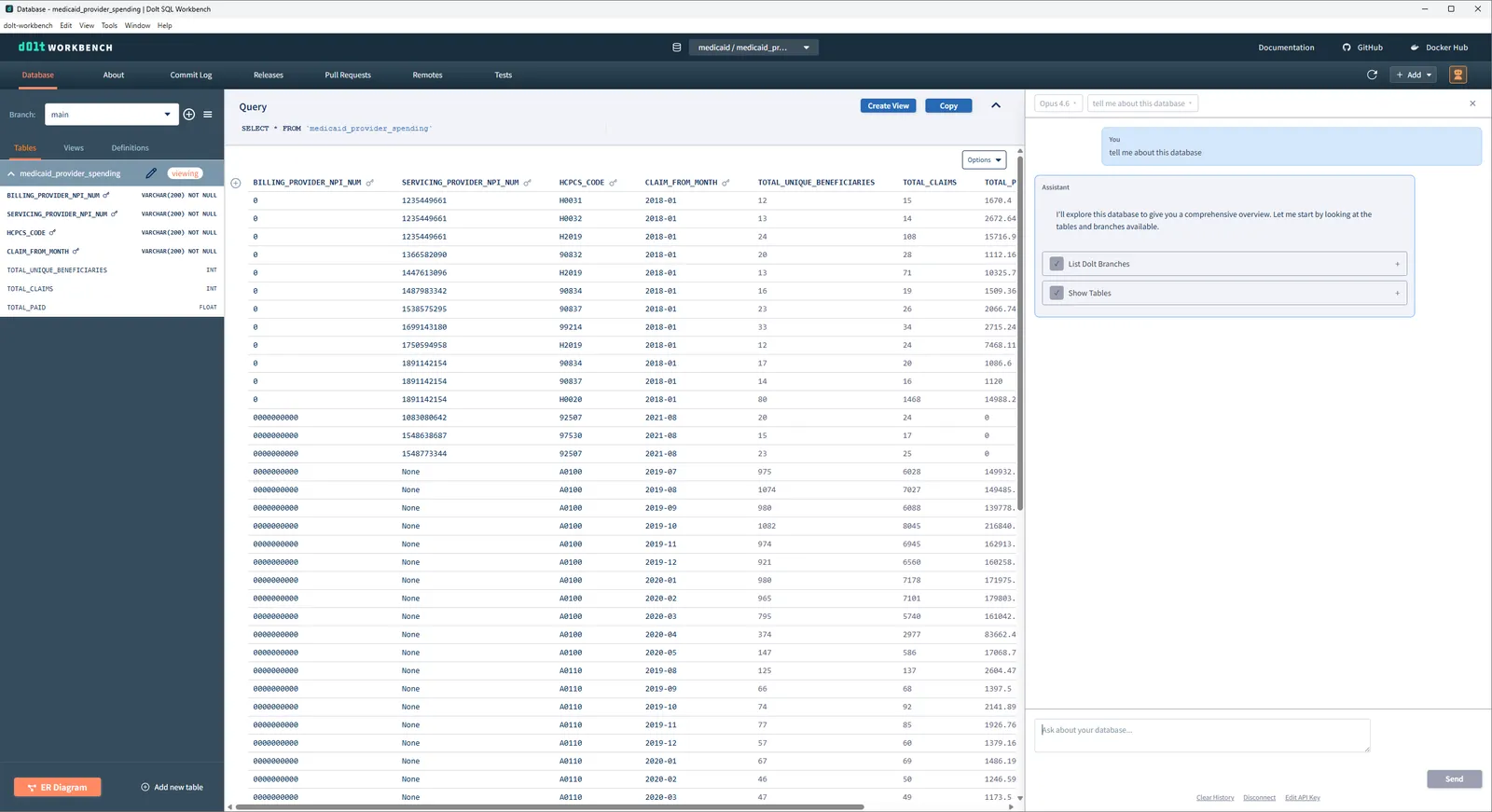
Dolt Workbench is so fun to use for data analysis, I’ve been hard at working publishing articles about the experience. A couple weeks ago, I published a suspicious payment analysis of the newly-released Medicaid payments dataset. Last week, I published an article showing you how to analyze the data yourself using Dolt Workbench agent mode. In that article, I teased an upcoming analysis on Chicago’s ambulance service. As promised, here we go!
Chicago Ambulances Are Expensive#
The City of Chicago operates its own ambulance service under National Provider Identifier (NPI) 341600000. Most cities have public ambulance service. Moreover, a collection of state and local laws usually require ambulance service to be provided regardless of the user’s ability to pay. If ambulance users are insured by Medicaid or uninsured, Medicaid foots the bill for the ambulance service provided.
Medicaid allows for states to set rates for ambulance service at the local level meaning each city ambulance service sets it’s own cost. Medicaid itself sets a fee schedule for services, but the fee schedule can be overridden. Under 42 CFR Part 413 and Section 1903(w)(6)(A) of the Social Security Act, government-owned providers like a city fire department can be reimbursed at their actual cost of providing Medicaid services, not just the standard fee schedule rate.
So let’s look at the cost of ambulance service Chicago charged to Medicaid over the seven years in our dataset. The costs below include two procedure codes: Basic Life Support (A0427) and Advanced Life Support (A0429).

The cost to Medicaid to provide ambulance service in Chicago increased from $16.1M in 2018 to $231.7M in 2024.
Just Chicago?#
Is this ambulance cost increase just happening in Chicago or is this a trend across all city ambulance services? Let’s look at 2024 Medicaid costs across a number of comparable city’s ambulance services.
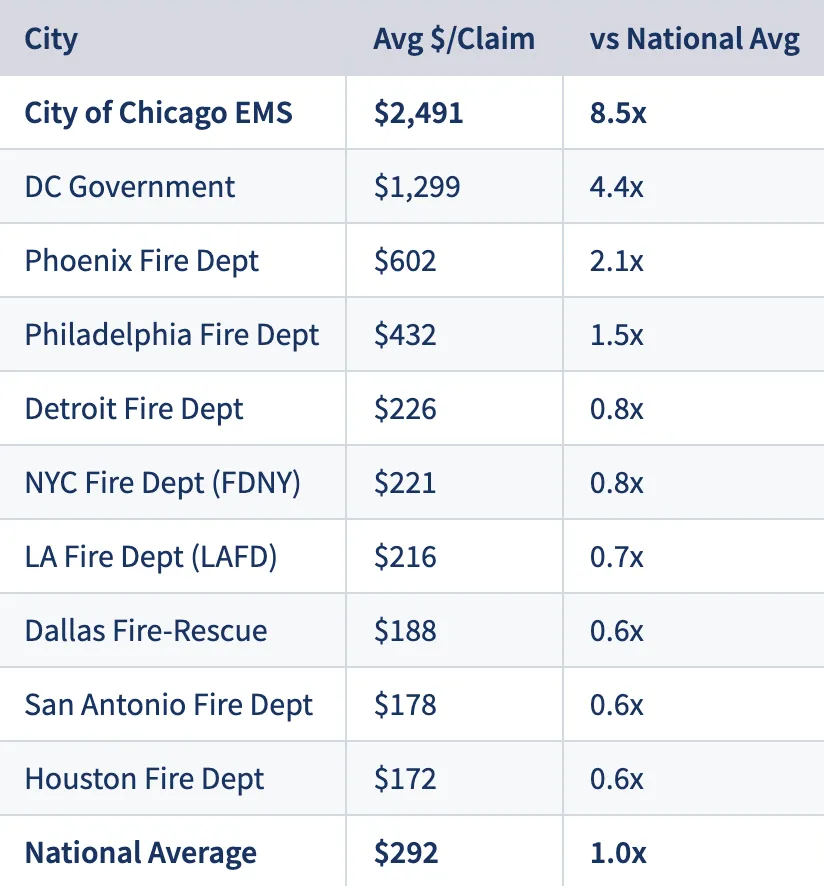
Something is definitely making ambulances expensive for Medicaid in Chicago. The cost per claim is 8.5x the national average and almost 2x Washington DC, the second largest outlier. Other large cities like New York City and Los Angeles seems to get economies of scale in their ambulance service, billing Medicaid less than the national average.
What Happened?#
So what has caused the Medicaid cost of ambulances in Chicago to rise since 2018?
This goes back to 42 CFR Part 413 and Section 1903(w)(6)(A) of the Social Security Act, which, as previously mentioned, allow government-owned providers to be reimbursed on a cost basis instead of a standard fee schedule rate. In 2019, the Illinois legislature introduced the Illinois Ground Emergency Medical Transport (GEMT) program. This program allows cities in Illinois to submit an annual cost report documenting their cost to provide ambulance service. If their cost exceeds the standard Medicaid fee schedule reimbursement, they receive a supplemental payment to cover the gap. Chicago began participating in the GEMT program in 2020 and receiving supplemental cost-based reimbursement on top of the base fee schedule.
Just Expensive?#
Is it just particularly expensive to run an ambulance service in Chicago? Or is something else going on?
An excellent analysis by A City that Works explains the whole City of Chicago ambulance revenue picture. Chicago does ~200,000 ambulance transports per year. In 2024, it collected roughly $300 million per year in ambulance revenue, of which $232M was provided by Medicaid. Ambulance revenue is up from $64M before GEMT. The entire EMS personnel budget is $82 million so the ambulance fees generate far more revenue than it costs to run the service.
So it’s not just expensive to run ambulances in Chicago. Something else is going on.
How Is This Happening?#
The key thing about the GEMT program is that the city determines its own costs. There is an ongoing debate about what can be included. In 2022, the Center for Medicaid and Medicare Services (CMS), the federal agency in charge of Medicaid reimbursement, issued a bulletin stating cities could not include a number of things in their costs including:
- Fire suppression costs (firefighters, fire trucks)
- Capital expenditures and indirect costs
Chicago’s Inspector General has even published an audit of these costs noting Chicago eliminated its Office of Compliance in 2012. The inspector general recommended re-establishing an Office of Compliance to keep a closer eye on these costs.
The Department of Government Efficiency (DOGE) specifically called out Chicago for its ambulance costs. The federal government may be realizing that Chicago is inflating its ambulance cost.
Why Is This Happening?#
Chicago is in a budgetary crisis, projecting a $1.15B budget shortfall in 2026. This budget crisis isn’t new. Let’s align the city’s budget woes with its ambulance prices.

In a 2019 Chicago Sun Times article, Chicago’s own Aldermen Raymond Lopez publicly questioned how the budget could be considered balanced when it depended on $163 million from the federal government.
At this point, it’s pretty clear to me that the City of Chicago is using its ambulance service to extract money from Medicaid to fund other government services.
Are Other Cities Doing This?#
Analyzing the data we find four cities have tried this funding loophole: Chicago, District of Columbia, Philadelphia and Los Angeles.
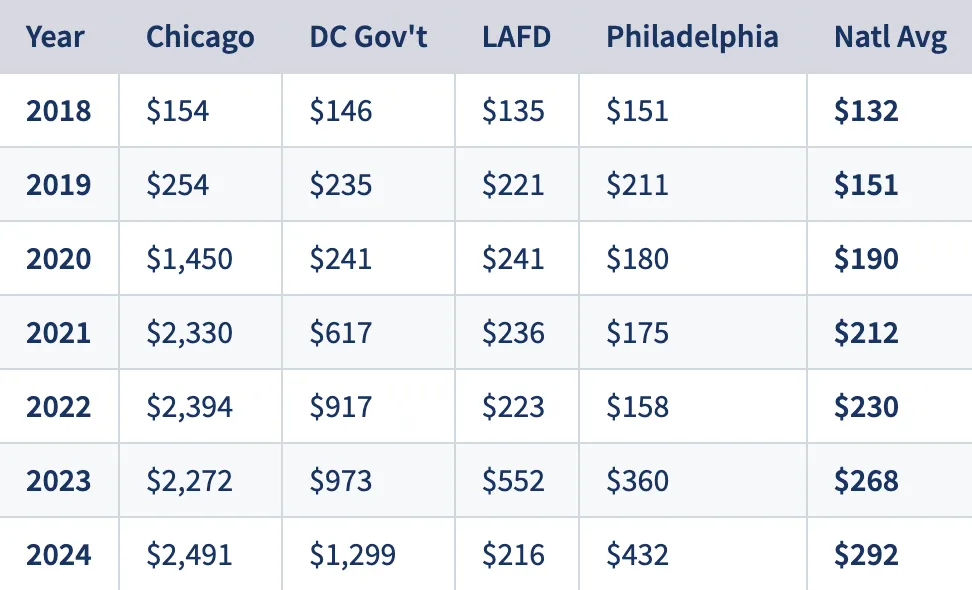
The District of Columbia has clearly taken advantage of this loophole since 2021 and costs continue to rise. On this trajectory, DC will catch up with Chicago in a couple years. Philadelphia started taking advantage of this loophole in 2023 and costs have almost tripled since.
Los Angeles used the loophole in 2023 but reduced their costs in 2024. The Paragon Institute specifically called out California’s Public Provider Ground Emergency Medical Transport Intergovernmental Transfer (PP-GEMT IGT) program introduced in 2023 as a “funding gimmick.” It seems California’s inspector general or CMS was able to get Los Angeles’ costs under control.
Change the Law#
Clearly, 42 CFR Part 413 and Section 1903(w)(6)(A) of the Social Security Act needs to change. At least three cities are cooperating with their states to extract money from Medicaid using ambulance service as a cover. There is not enough oversight at the federal level to allow city governments to bill Medicaid based on cost of services rather than a standard fee schedule. This loophole has cost the federal government over $1B over seven years just in Chicago. At least, change the law. Or maybe, hold these cities accountable for the inflated Medicaid charges?
Conclusion#
Did you find this analysis interesting? All of the research and tables were generated using Dolt Workbench agent mode. The Medicaid Payments dataset is free and available on DoltHub for you to audit or reproduce my findings. Need help getting started? Come by our Discord and we’ll help you.